Stop wasting experts' time answering the same questions over and over
Your newer people get answers without waiting on someone senior.
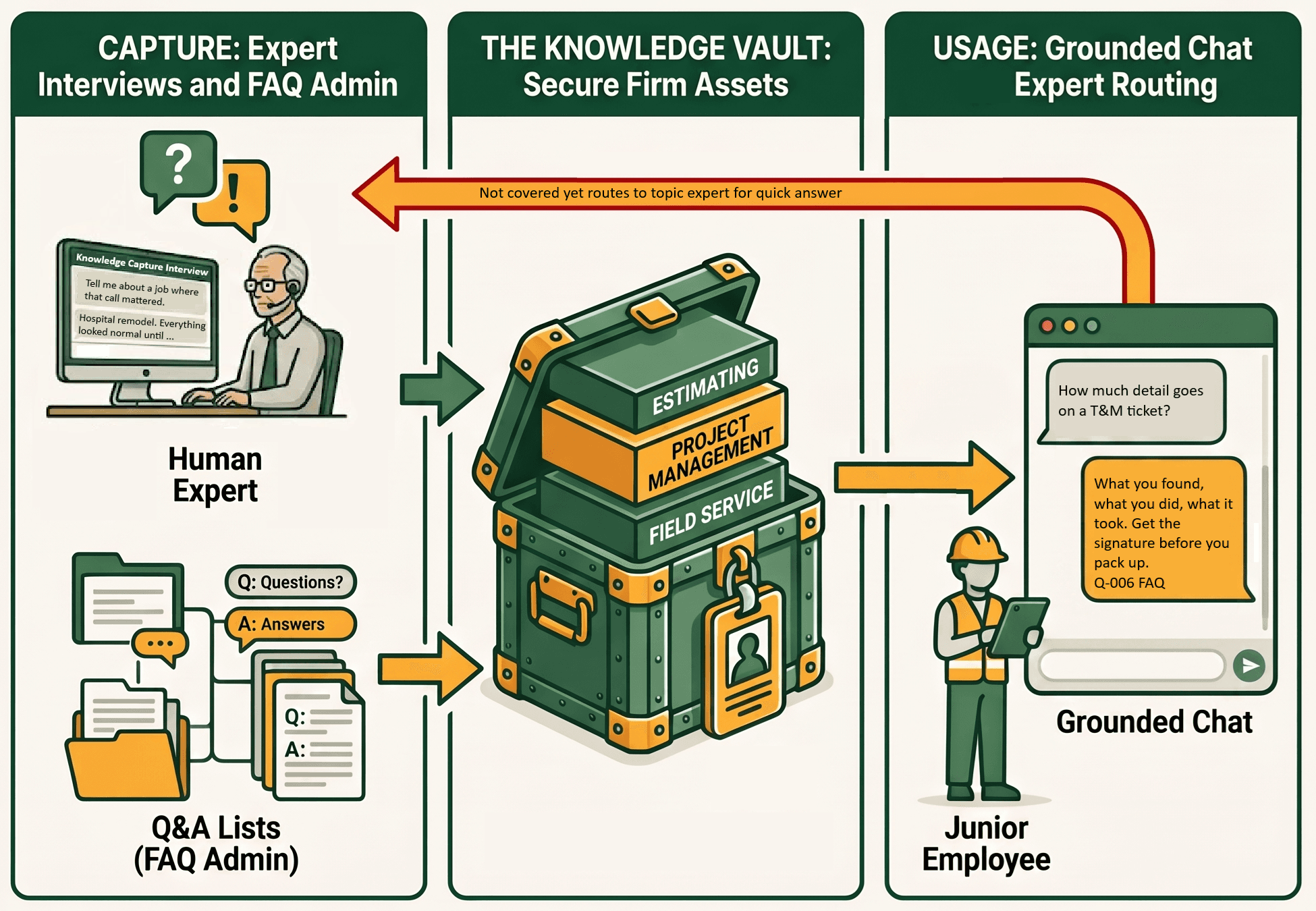
When an answer isn't known yet, the question gets routed to the right expert.
Their answer gets routed back to whoever asked, and recorded for next time.
We handle simple answers as well as the hard judgment that costs you when it's wrong.
Ask questions on our platform or yours.
When your experts leave, their knowledge stays.
Do not RFI a favorable ambiguity
You have found a favorable scope ambiguity that competitors likely have not.
Do not issue an RFI on it. Carry it as a qualification instead.
An RFI becomes a public addendum that hands your catch to every other bidder and forces everyone to price high.
One of 69 items in the example artifact
Built on a technique used for forty years to capture expert judgment in aviation, military, and healthcare.
Your firm runs at a few people's capacity
Each area has its one person. The estimator who knows which lead times to verify. The super who knows how that GC behaves once the job is running. The service manager who knows which callbacks are really a dimmer problem. Every hard question in their area waits for them.
You can't see what your team doesn't know
The same gap gets discovered five times by five people, and none of it is written anywhere. Nobody logs the questions, so you find out what your firm was missing after it costs you something.
The "why" never transfers
Your ERP has the numbers. The drawings have the scope. Neither holds the judgment behind them, and a record of what someone did without the why teaches a new hire nothing.
Two kinds of answers. One place to ask.
Some of what your firm knows is already settled. Whoever owns it can write it down in a couple of minutes. How you want a T&M ticket written. What to check first on a callback. That goes in as a written answer, and it stays theirs to change.
The rest starts with "it depends." What to qualify instead of asking. Which lead time not to trust. When the usual rule stops applying. The person who holds it can't just write it down, because they don't know they know it. The conditions only come out under questioning.
That's what the interview is for. A structured, AI-guided conversation walks your expert through jobs they actually ran and asks what a sharp apprentice would ask: not "what did you do" but "what told you to look there, and what would have happened if you hadn't." It captures the reasoning behind the calls, in their words, and your firm owns the result.
It's built on the Critical Decision Method, an established technique used for decades to capture expert judgment in aviation, military, and healthcare, the fields where the difference between a senior and a junior is measured in outcomes.
Your team asks the same way either way. They don't need to know which kind of answer they're getting.
Starts with what you know. Grows from what your team asks.
Start with what's already known.
The settled answers go in first: how you want things done, what to check first, the process everyone should follow. For an area where the judgment has never been written down, a capture interview seeds it in one session instead of one question at a time.
Your team asks.
On our platform or yours. They ask the way they'd ask your most experienced person, and get an answer with a link to the captured item behind it, so they can check it rather than take it on faith.
What nobody has written down goes to the expert.
When a question falls outside what your firm has captured, it says so rather than guessing, and routes it to the person whose area it is. A few minutes of their time, not a meeting.
The answer comes back and stays.
It reaches whoever asked, and it's part of the knowledge base from then on. The next person who asks gets it without anyone being interrupted.
"So you're replacing me?"
Some ask it out loud. Most just think it, and then give you the safe answers instead of the good ones. The rules you most need are the ones they're least inclined to hand over.
What makes the answer credible isn't reassurance, it's control. They confirm, edit, or reject every item. Nothing enters the document they didn't approve. They set what's shareable and what stays internal. Their name is on it.
The first capture interview establishes the baseline. Judgment moves as jobs teach you things: a GC's pattern shifts, a lead time normalizes, a rule that worked stops working. When someone asks a question the document doesn't cover, it says so, and the question goes to the expert. They answer it once, in a few minutes, and it's there from then on. Nothing changes in it without them.
And a knowledge base doesn't walk a job site. It doesn't read a room, call in a favor, or know which engineer's drawings to distrust this year. What it does is answer the questions they're tired of answering, so the only ones that reach them are the ones that actually need them, and their reasoning reaches the juniors when they aren't standing over them. It works for them directly too: run a bid against their own captured rules before it goes out, and the things that slip on a busy week get caught.
The framing that lands with senior people is the one they already use about their own careers: the move from being the person who makes the calls to building what the team runs on when you're not in the room.
What your firm gets
- Everyone works more like your best person. Hard-won reasoning that used to live with one person becomes something the whole team can apply, including on the jobs that person doesn't have time to review.
- You stop being one person deep per area. The judgment that decides whether a job makes money is documented and owned by the firm, not carried around in one head that can retire, quit, or get recruited.
- New hires ramp on real firm judgment. Not trial, error, and a year of expensive mistakes.
- Quiet disagreements surface. Where two of your people have been applying different rules to the same situation, the capture makes it visible so you can decide which one is right.
- Your AI tools answer like your firm. Copilot, ChatGPT, Claude, and Gemini only know what they've read, and none of it is yours unless someone has fed it your material. Point one at your captured judgment and it answers like your firm instead. If you haven't set anything up, our chat answers questions with a link to the source behind each one. It's the starting point and the knowledge base moves into your own tools whenever you're ready.
- You find out what your firm doesn't know. Every question that falls outside what you've captured gets recorded. You see which gaps come up repeatedly and who is being asked, instead of finding out when one of them costs you something.
This is the part that should be non-negotiable, so we put it in writing.
- Your firm owns the captured knowledge outright. It's your knowledge and your asset, exportable in plain markdown. A text file any tool can read, on your own machine if you want, that will still open in ten years whether or not we're still here. Nothing depends on staying our customer.You can also export a focused subset. Pick the decisions that matter for a particular kind of work and get a smaller file scoped to it, ready to drop into Claude as a skill so it applies on its own without anyone pasting anything.
- It's never shared, never sold, and never used to train a model. The interview runs through a commercial AI provider under terms that exclude training. Nothing else touches it, and nothing outside the interview enters the document.
- You control what's named. Real names of GCs, owners, engineers, and people can stay internal or be masked in any version that leaves the firm. Your call, per export.
- Handled by someone who's worked with regulated data. 25 years in enterprise B2B platforms, including payments systems operating under SOC 2 and encryption requirements. Your captured judgment gets the same care.
How We're Different
We don't replace your systems.
Your estimating software, your ERP, the GC's project platform: they all capture data. None of them capture the judgment behind it, which is the layer we build, and it sits alongside everything you run.
Nothing for your team to learn.
They ask a question in plain language and get an answer, on our platform or in the AI tool they already use. No rollout, no training, no new system for anyone to administer.
It isn't a documentation project.
No consultant camped in your office, no template for your people to fill out on top of their real work, no initiative that stalls in month three. It grows because your team was asking questions anyway.
Vendor-agnostic.
We don't take referral fees or resell anyone's software, so the capture serves your firm rather than a tool we'd profit from recommending. If you later want us to keep the document current as your judgment changes, or connect it to the tools your team uses, that's a separate and optional service. The document itself stays yours either way.
The first capture is free, in exchange for your feedback. One area of judgment, captured and delivered, and an honest conversation about what worked and what didn't.
What it costs your expert is one interview, 60 to 75 minutes, with no preparation beforehand, and then a review of what was captured. After that they only hear from it when someone asks a question nobody has answered yet, and that takes about five minutes.
You own the file either way. It is plain text, it opens in anything, and nothing about it depends on us still being here.
Pricing beyond the first capture is not set yet. We are working with the first few firms to get it right, and you will know what it is before you decide anything.
Answers, not hedges.
Those hold data: quantities, pricing, documents, dates. This holds judgment: why the number is what it is, what got qualified and why, which quoted lead time your team didn't trust. Different layers. It sits alongside your existing systems rather than replacing them, and it's the layer they were never built to hold.
Those hold what someone wrote down. Two things are different here. Nobody reads a procedure at the moment they have a question, so they ask a person instead. And a shared drive never tells you what's missing from it: when someone asks something your firm hasn't captured, this says so and routes it to the person who knows.
Your existing material isn't wasted, either. We can load what you already have to start it off, so you're not writing answers from scratch.
You check it, the same way you'd check a takeoff someone handed you or a spreadsheet you didn't build. The difference is what checking costs. Every answer points back to the specific captured item behind it, so it's checking a source rather than redoing the work. And it flags questions that fall outside what your firm has captured instead of filling the gap with generic advice.
Yes. The output is a plain text document, so your team loads it into whatever they already use and asks questions against it. Nothing to integrate, no vendor to commit to. If you switch tools next year, the document goes with you. For Claude there's a second option: export a subset as a skill file, and it applies automatically when someone asks about something it covers.
Yes, with Claude for Microsoft 365. Export the rules that apply to the work, load the file once, and your estimator can ask in the sidebar while they're in the sheet. The answer cites the rule it came from, and it writes into the cells only when they approve it.
No. Most of what a firm knows is already settled, and whoever owns it can write it down in a couple of minutes. The interview is for the judgment that starts with "it depends," where the conditions only come out under questioning and the person holding it couldn't just write it down. Both kinds end up in the same place, and your team asks the same way either way.
One scheduled interview, no prep beforehand, then they review what we captured. After that, they only hear from it when someone asks something nobody has answered yet, and that runs about five minutes. Not an ongoing project.
No install, no server, nothing for IT to run. If your team asks on our platform, someone sets up who can see what, which takes a few minutes. If you'd rather keep it in your own AI tools, it's a text file.
No. A document doesn't bid a job, read a room, or know which engineer's drawings to distrust this year. Novel situations still need the person. What it does is stop the same questions getting re-asked and give newer people something to work from besides someone else's availability, so your firm depends less on any one person being in the office that week.
Start by asking rather than announcing. Control settles most of it: they confirm, edit, or reject every item and set what stays internal. And it doesn't end at the first session. As their judgment changes, updates run back through them, so they stay the authority on what it says.
A firm can pay a retiree for a few sessions.
Your firm does, outright. It's your document in plain text, and you can copy it, edit it, or take it anywhere. We never share it, sell it, or use it to train a model. And if the person whose judgment it captures leaves, the document stays. That's the point of doing it.
No. The interview runs through a commercial AI provider under terms that exclude training on customer data, and nothing else touches it. Your captured judgment is used to build your firm's document and, if you choose, to ground your firm's own AI tools. It is never shared, sold, or used to train a model.
The first capture is free for early participants, in exchange for your feedback. You see the document before there's any conversation about money. Ongoing work would be keeping it current as your judgment changes and connecting it to the tools your team uses. We haven't set that pricing yet, and we'd rather do a few captures first than guess.
See your firm's judgment working before you commit to anything.
The first capture is free in exchange for your feedback. One conversation with someone on your team, then your people can ask questions against what it produced and see what comes back.